Amazon FBA Fees Explained: 2026 Seller Guide
Amazon FBA, Seller Fees, 2026 Guide
Amazon FBA Fees Explained: 2026 Seller Guide
Understanding your 2026 Amazon FBA fees is essential if you want to price correctly, protect your margins, and decide when FBA really beats fulfilling orders yourself.
What Amazon FBA Is and How It Works in Practice
Fulfillment by Amazon (FBA) means Amazon stores your products, picks and packs orders, ships to customers, and handles customer service and most returns. You focus on sourcing and marketing; Amazon handles the physical logistics. You ship inventory to Amazon’s fulfillment centers, create offers on your listings as “Fulfilled by Amazon,” and pay a set of fees each time an item sells or sits in storage. In return, you usually qualify for Prime eligibility and faster delivery, which can boost conversion and sales volume.
Main Amazon FBA Fee Types in 2026
Amazon did not add new fee categories in 2026, but it did increase most fulfillment-related charges slightly (about $0.08 per unit on average) and added a 3.5% fuel and logistics surcharge on FBA fulfillment fees in the U.S. and Canada.1 Here are the core fees you must plan for:
Referral fees: A percentage of the item’s sale price (including shipping and gift wrap). In most categories this ranges from about 8–15%, with some categories slightly higher or lower. This fee applies whether you use FBA or fulfill yourself.
FBA fulfillment fees: This is Amazon’s charge to pick, pack, and ship your order. It’s based on size tier (small standard, large standard, or oversized) and weight, and in 2026 it also includes the 3.5% fuel and logistics surcharge layered on top of the base rate.2
Monthly inventory storage fees: Charged per cubic foot of storage space your inventory occupies. For non-dangerous standard-size items in U.S. fulfillment centers, 2026 rates are around $0.78 per cubic foot January–September and $2.40 per cubic foot October–December.3 Dangerous goods and bulky items cost more.
Inbound placement and inbound defect fees: Inbound placement fees apply when Amazon redistributes your inventory across its network; standard-size items saw an average $0.05 per unit increase in 2026.1 A simplified $0.60 per unit inbound defect fee applies if shipments arrive late, mis-delivered, or missing units.1
Other operational fees: These include returns processing fees (especially for apparel and shoes), removal and disposal fees when you ask Amazon to send back or destroy inventory, and long-term or aged inventory surcharges if stock sits too long—often kicking in at 181 days and 365 days, or when you hold more than 28 days of supply under the low inventory-level rules.2
Worked Example: Fees on a $30 Standard-Size Product
Assume you sell a non-dangerous, large standard-size product for $30, priced between $10 and $50, outside the holiday peak period. We will use reasonable 2026-style numbers for illustration; always confirm exact rates in Amazon’s Revenue Calculator.
Sale price: $30.00
Referral fee (15%): 0.15 × $30 = $4.50
FBA fulfillment fee (large standard, $10–$50): suppose the 2026 non-peak rate is about $7.13 per unit, plus the 3.5% surcharge. That adds roughly $0.25, for a total fulfillment fee of about $7.38.1
Monthly storage (average): If one unit uses 0.1 cubic feet and sits one month Jan–Sep, storage is 0.1 × $0.78 = $0.08. In Q4, that same month would be about $0.24.
Ignoring inbound and occasional returns for simplicity, your core FBA costs per unit look like this:
Item | Amount |
|---|---|
Sale price | $30.00 |
Referral fee | −$4.50 |
Fulfillment fee (incl. 3.5% surcharge) | −$7.38 |
Storage (1 month, Jan–Sep) | −$0.08 |
Total Amazon fees: about $11.96. After fees, you receive roughly $18.04 before product cost, inbound shipping, and advertising. This is why you must model fees before you commit to a product.
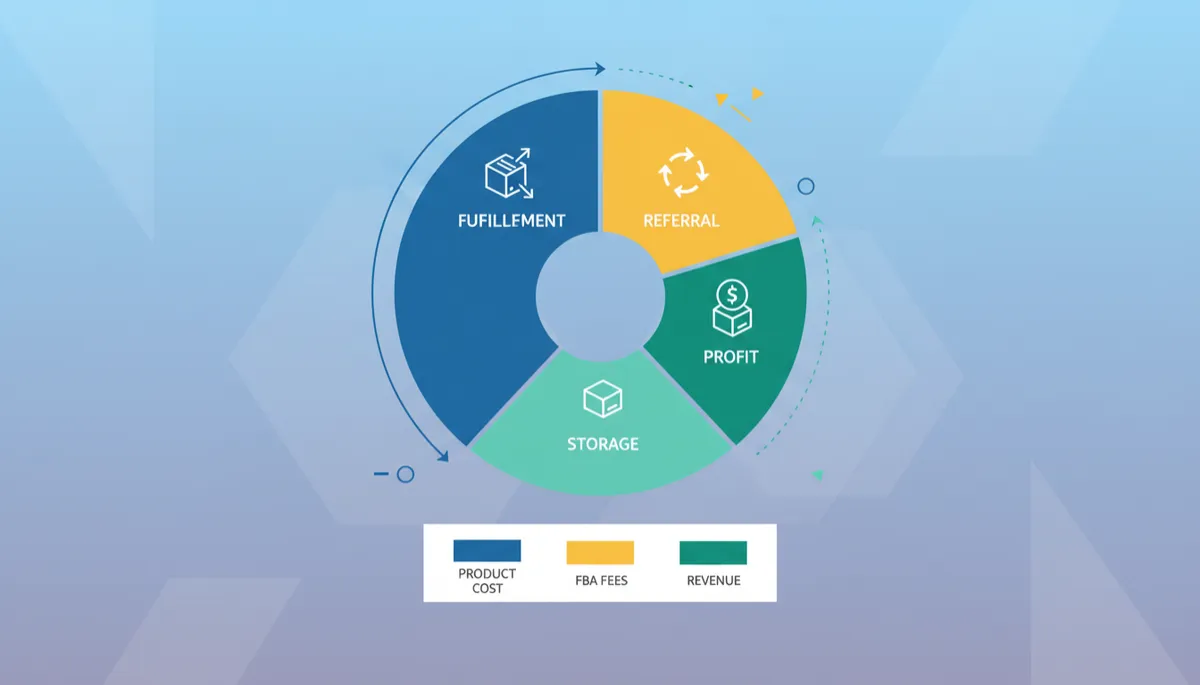
Seeing each fee component clearly makes it easier to price for profit.
How Fees Differ by Size Tier: Small, Large, and Oversized
Size tier is one of the biggest levers you control. In 2026, standard-size products are split into small standard and large standard, while anything beyond those limits becomes oversized (or extra-large/bulky). Each jump in tier usually adds dollars, not cents, to your fulfillment fee.
Small standard-size: Cheapest to fulfill. If you can design packaging to stay in this tier, you often save $1–$2 per unit versus large standard, and much more versus oversized. Low-price FBA discounts under $10 are strongest here, averaging about $0.86 per unit in savings.2
Large standard-size: Higher base fee, but still reasonable for most consumer products. The $7.13 example above is in this band for a mid-priced item, before the surcharge and peak adjustments.
Oversized and extra-large: Fees climb sharply because these items take more space and handling. A 0–50 lb extra-large item can exceed $40 per unit in fulfillment fees during non-peak, with higher charges in Q4 and potential Overmax surcharges if you exceed dimensional thresholds.2
💡 Practical note: A small packaging redesign that nudges you from large standard down to small standard can be more profitable than negotiating a small discount from your supplier.
Five Practical Ways to Reduce FBA Fees in 2026
Engineer products for smaller tiers. Design packaging to meet small standard limits where possible. Trim excess cardboard, avoid oversized bundles, and test sample boxes with Amazon’s size guidelines before mass production.
Manage inventory to avoid surcharges. Use Amazon’s inventory and aged stock reports to keep 30–90 days of supply. Clear slow movers with coupons or outlet deals before they hit long-term or low inventory-level fees.
Avoid unnecessary Q4 storage. Because Q4 storage is several times higher, delay inbound shipments for non-seasonal products until closer to when you expect sales, and remove dead stock before October 15 where practical.
Bundle smartly. Create multipacks or bundles that increase average order value without pushing you into a higher size tier. The goal is more revenue per fulfillment fee, not just a bigger, more expensive box.
Use Amazon’s Revenue Calculator before you launch. Model your landed cost, FBA fees, and storage impact at multiple price points—especially around $9.99 vs. $10.99—since low-price discounts and fee steps can make lower prices surprisingly more profitable.2
FBA vs FBM: Which Is Cheaper?
With FBM (Fulfilled by Merchant), you or a 3PL store, pack, and ship orders. You still pay referral fees, but you avoid FBA fulfillment and storage charges. Instead, you pay carrier shipping, packaging, warehouse rent, labor, and software. For small, fast-moving items, FBA is often cheaper once you factor in Amazon’s shipping discounts, Prime eligibility, and higher conversion rates. For large, heavy, or slow-moving products, FBM or a hybrid approach can win, because FBA storage and oversized fees erode margins. The practical way to decide is to model both options per SKU using your real 3PL or in-house costs and Amazon’s published FBA rates.
Short FAQ: Common 2026 FBA Fee Questions
Do 2026 FBA fees apply to existing inventory? Yes. Once the new rates and surcharges went live (January 15 for base fees, April 17 for the 3.5% surcharge), they apply to all FBA units sold and stored, not just new shipments.
Are referral fees different under FBA vs FBM? No. Referral fees are tied to category and sale price, not fulfillment method. What changes between FBA and FBM are fulfillment, storage, and operational costs.
Where can I see my exact fees? Use Amazon’s Revenue Calculator, Fee & Economics Preview, and your Payments and Fee reports in Seller Central. These tools show current rates and how each fee hits your margins on a per-SKU basis.1
